
Most teams still create offers, sales documents, and presentation decks as separate manual jobs. One version gets written for reading. Another gets rebuilt for presenting. Then both get reformatted, restyled, translated, and adjusted again when the offer changes. That is slow, repetitive, and more expensive than it should be.
We built DECK/DOCS to remove that waste.
DECK/DOCS takes simple structured data points and turns them into full sales material. The same source can generate a polished document for reading, review, and forwarding, and it can also generate a presentation-ready slide deck for the sales conversation itself. We are no longer maintaining one artifact for document work and another artifact for slides. We are maintaining one structured source that can be rendered in the mode that fits the situation.
In practice those inputs can include the customer name, scope summary, validated POC status, rollout assumptions, pricing, roadmap notes, contact details, and client brand cues. The system assembles and renders that material, but a person still decides the commercial framing, checks the claims, and approves the final offer or deck before it goes out.
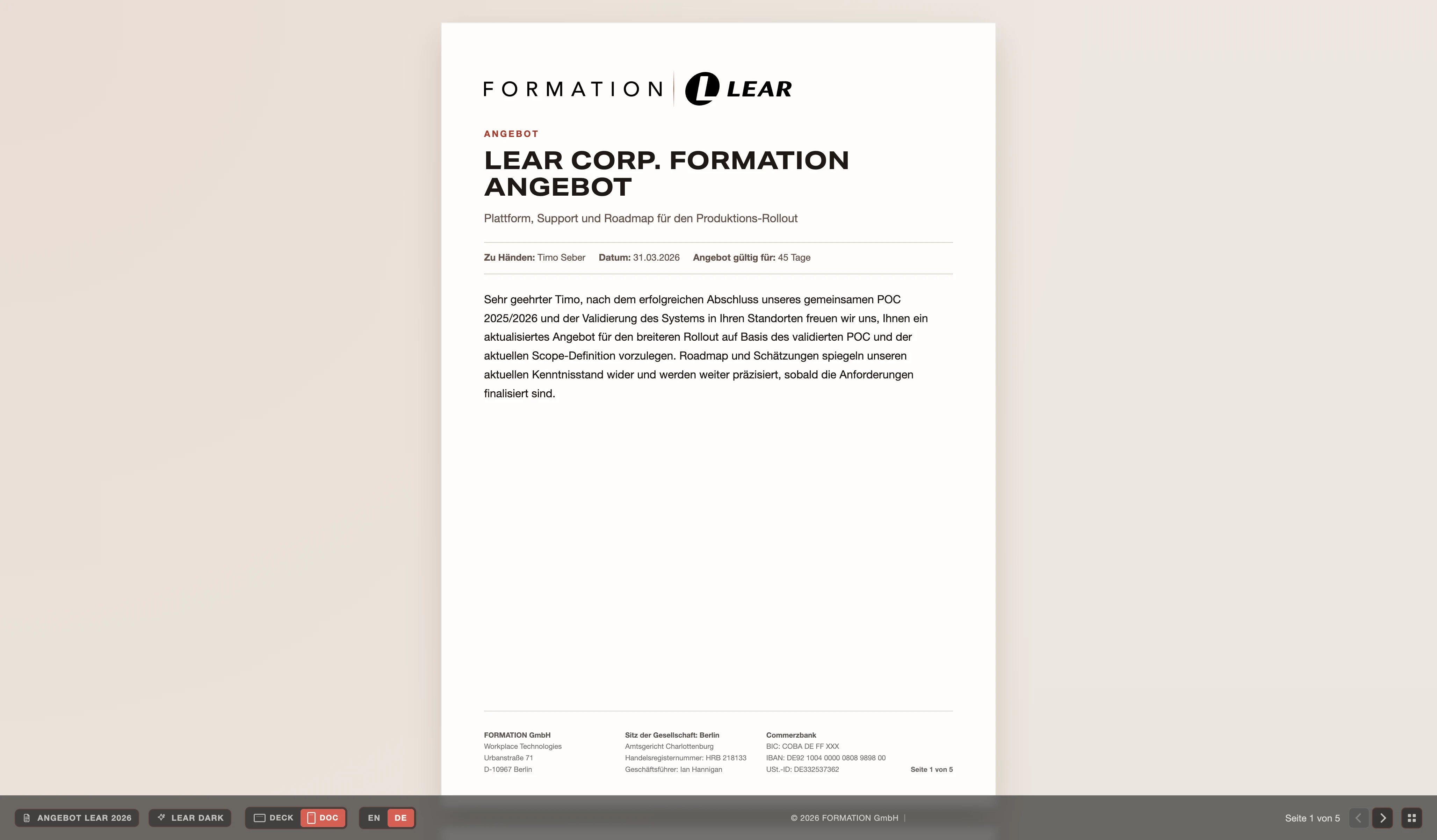
Slides and documents do different jobs. A document should be easy to read, scan, and share. A slide deck should pace attention, simplify hierarchy, and support a live conversation. Most teams know that, but they still end up rebuilding the same content twice. With DECK/DOCS, the content stays aligned because the system separates the source from the presentation logic.
Content and Style Are Separated
The core design decision was to separate content from styling.
The underlying offer logic, factual inputs, metadata, and structure live in one layer. The visual system lives in another. That makes the workflow much more flexible. If the message changes, we update the content layer. If the visual treatment needs to change, we update the style layer. If both need to move, they can still move independently instead of turning into one tangled production problem.
That separation also makes reuse realistic. Good structures do not disappear into old deck files. Strong layout logic does not stay trapped in one document. Once the system has a working structure, it can reuse it across new offers and new customer material instead of starting again from a blank page.
The Same Source Becomes Slides or Docs
One of the most useful parts of DECK/DOCS is that the same source can be viewed as slides or as a document without manual reassembly.
We can feed the system simple metadata, source notes, offer components, and structural guidance, and it can generate a visually strong sales deck that also converts cleanly into a readable document. The team is not paying twice for the same thinking. The same content system supports both reading mode and presentation mode, and the review owner can inspect both outputs before anything is sent.
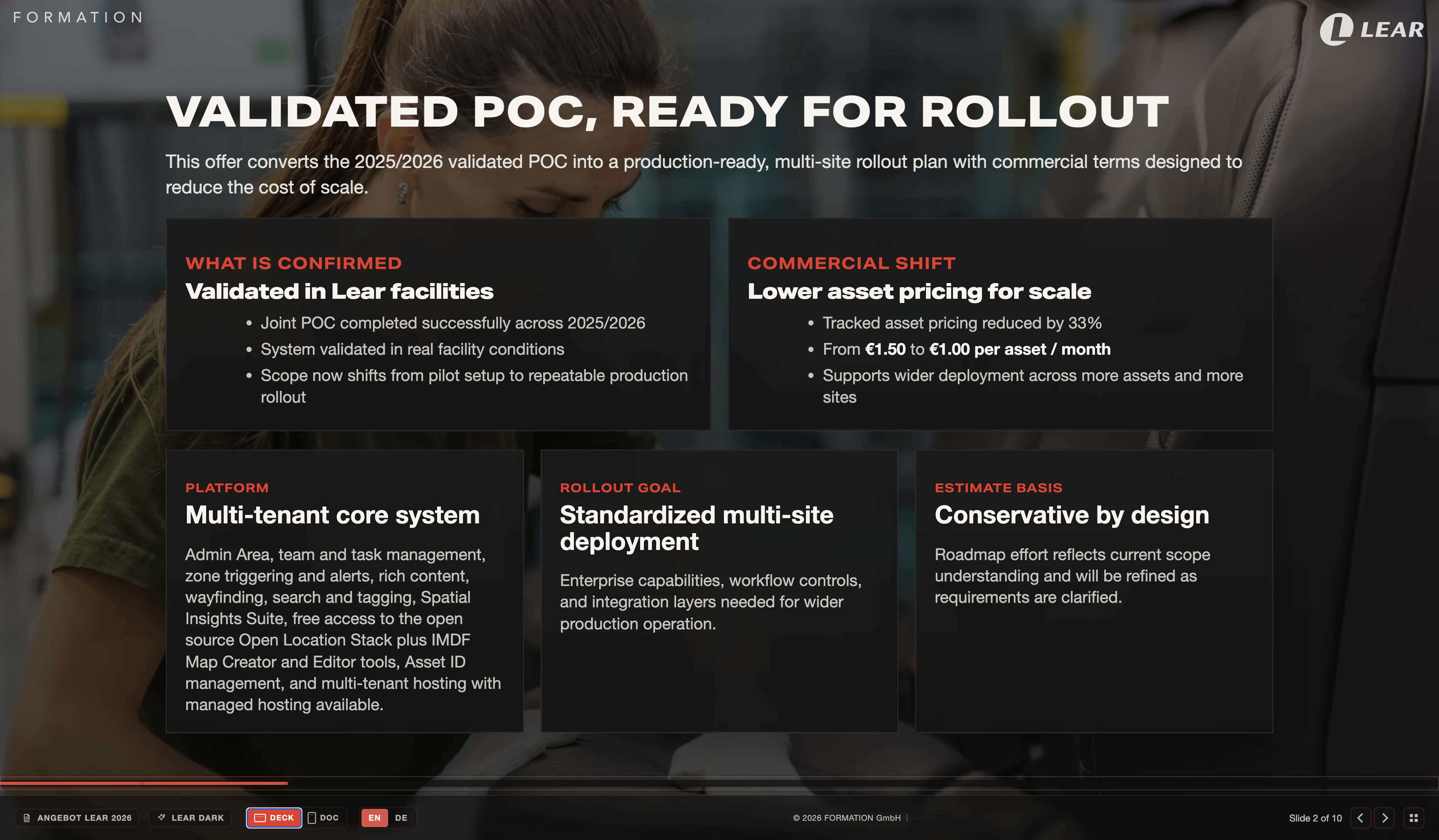
This helps review too. Some people want to review a document because they need detail and context. Others want to see the sales deck because that is how the story will actually be presented. DECK/DOCS supports both without forcing the team to maintain two drifting versions.
Language Becomes A Switch
Another practical gain is multilingual output.
Because the content is structured properly, we can switch a deck or document from English to German with a simple language toggle. Language becomes a switch instead of a separate production project. The structure stays intact. The styling stays intact. The underlying content logic stays intact. That removes a large amount of avoidable translation overhead and makes it much easier to keep customer-facing material aligned across both languages.
For a team working in German and English, this removes a common source of version drift and formatting rework. In most sales workflows, bilingual output is where extra production work starts to pile up. DECK/DOCS cuts much of that rework because the language layer is built into the system rather than bolted on later.
Client Branding Gets Easier Too
We also use the style layer to adapt material to the visual language of a client.
We can feed the styling workflow a client website and use it as input for structure and styling decisions. We are not only swapping a few colours. We are giving the system cues about hierarchy, tone, rhythm, and corporate identity so the generated deck starts much closer to the client context. A person still decides which cues matter, what to keep, and where the design needs correction.
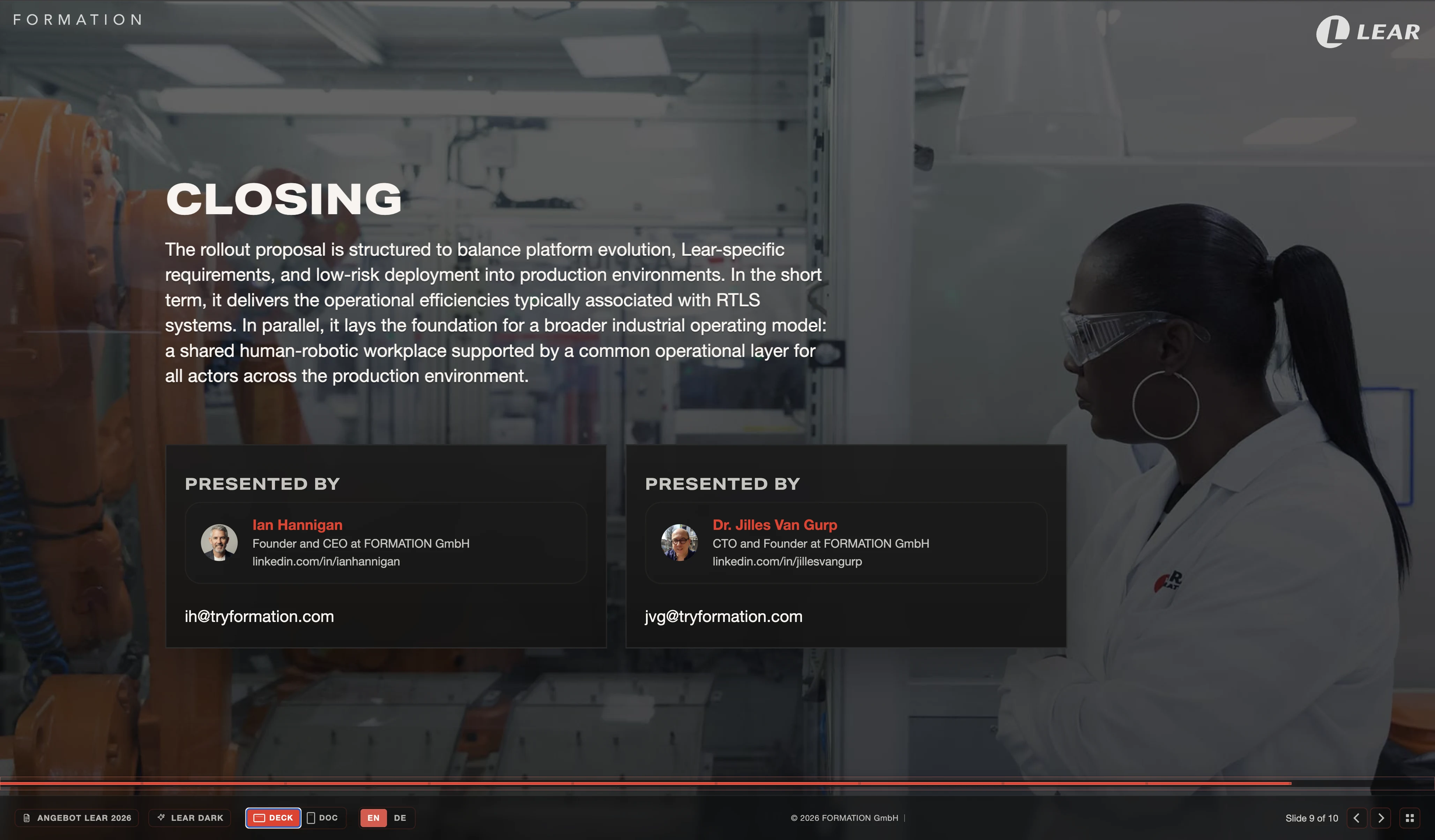
That is especially useful for proposals, enterprise sales conversations, partnership material, and any situation where visual alignment affects trust. A small team can produce more tailored material without absorbing the usual cost of manual design adaptation every time.
The Savings Are Already Clear
The practical result is straightforward. DECK/DOCS already saves XYZ several days of production effort each month across offer assembly, slide preparation, translation, and design cleanup.
The savings show up in all the places where teams normally lose time: duplicated formatting work, manual slide rebuilding, translation work, style cleanup, version alignment, and repeated offer assembly. Once the system carries more of that burden, the team gets faster output, cleaner consistency, and more room to focus on the quality of the actual sales story.
Structured AI workflows matter when the inputs, layout rules, language layers, and review steps are explicit. That is what makes the output easier to reuse, easier to inspect, and cheaper to produce repeatedly.
DECK/DOCS shows that pattern clearly. Simple inputs become polished offers. The same source becomes docs or slides. English becomes German with a switch. Client styling becomes easier to adapt. A workflow that used to consume repeated manual effort becomes much lighter to run.
For XYZ, it is a practical operating workflow that makes offer production faster and easier to control.